


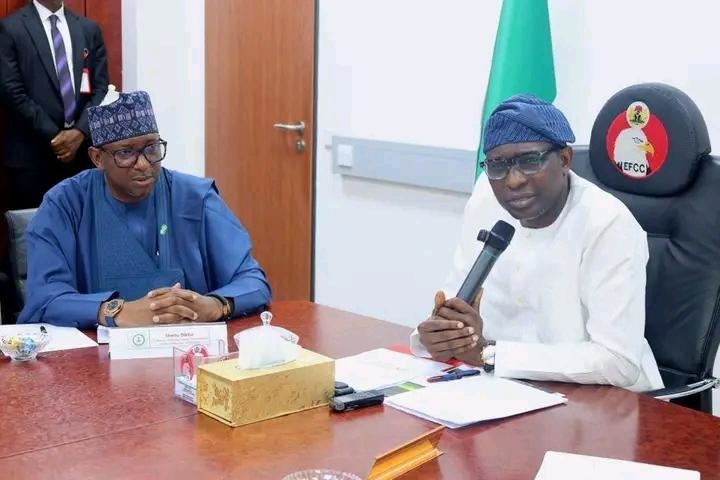
We Are Still Investigating Missing Sports Funds, EFCC Warns Shehu Dikko
By Abdulgafar Oladimeji
Nigeria’s frontline anti graft agency has notified the National Sports Commission, NSC that investigation into the misappropriation of sports funds are still ongoing.
The Executive chairman of the Economic and Financial Crimes Commission, EFCC, Ola Olukoyede revealed that the anti graft agency is still top of the alleged cases of the misuse of public funds by assigned Nigerian sports officials.
The anti graft boss dropped the hint , while addressing the chairman of the National Sports Commission, Mallam Shehu Dikko , during a strategic engagement held with the Economic and Financial Crimes Commission (EFCC) , on Friday May 29.
According to the public statement issued by
Director Information and Public Relations,
NSC, Kehinde Ajayi, said the meeting is aimed at boosting integrity and ethical practices in Nigerian sports administration and the entire ecosystem.
The EFCC honcho is quoted as saying “We always want to engage in the spirit of working together. As you would have known, the EFCC has had cause to investigate some of your predecessors and some of the case files are still alive. I think there is the need for us to work together. If there are things that we need to prevent, we have to prevent them before they lead to what will attract investigations,”
He further warned that , “We now have a department, called the Fraud Risk Assessment and Control, FRAC, basically set up for prevention purposes. That department will work with you so that we can set up our fraud risk compliance template for your Commission on those things that you have to watch out for in the areas of procurement, contract award and management of funds.
Olukoyede lamented that “In the time past, some of the funds , we earned from international bodies were mismanaged and we wouldn’t want such to repeat itself anymore. Some of the contracts you have signed and MoUs would also be part of it, particularly for your new agency, the National Anti-doping Agency.”
Earlier, NSC Chairman Mallam Shehu Dikko , at the engagement held at the EFCC headquarters, had reiterated the reasoning behind the establishment of the National Sports Commission, the Strategic vision Objectives and the projected outcomes as well as the achievements to date.
Dikko said “In October 2024, President Bola Ahmed Tinubu GCFR took the bold decision to scrap the Sports Ministry and set up National Sports Commission so as to change the entire sporting ecosystem, harness the potentials of sports economy and make sports one of the key drivers of the economy.
He further pointed out that “We had been too focused on participation in international competitions spending so much funding to the detriment of the domestic sports ecosystem and winning little so there was a need to reset and restructure the sector which was the anchor of Mr. President’s decision. Infact, the very day the President set up the NSC, the National Assembly had called for a state of emergency in Nigerian sports.
He boasted that “Thus when we came on board we developed a clear strategic plan of action and set up the Renewed Hope Initiative for Nigeria Sports Economy (RHINSE) framework with three pillars of reset, refocus and relaunch to meet the mandate of the President. This means that sports is now treated as a national asset. Being an asset, the sector should contribute at least 3% of the nation’s GDP annually, create millions of jobs, attract Investment and generally be a driver of economic advancement across several sectors. Therefore sports is now beyond the competitions. It has to be clean and ethical so as to attract and sustain investors.”
“This is why the President speedily assented to the Nigeria Antidoping Bill into law which had been in the works for over 20 years but under the watch of the President it was duly concluded. This consequently set up the National Antidoping Center, all geared towards making sports clean and ensure Nigeria is compliant to the global benchmarks. We have also set up the NSC Independent Sports Integrity Board to ensure that there is integrity and compliance in the sector and be a preventative tool against any unethical practices. We have therefore come to collaborate with the EFCC to this effect among others”,


